
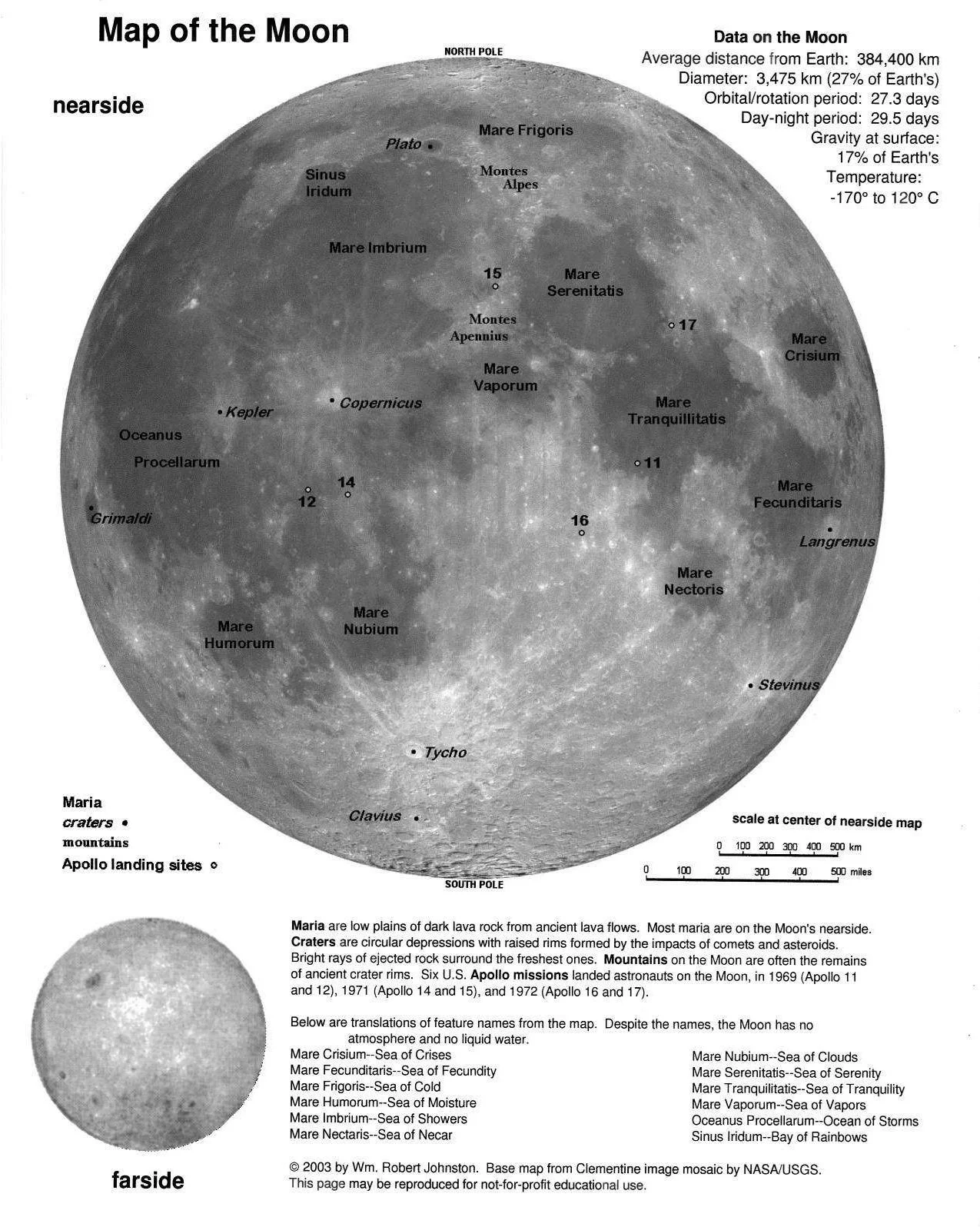
The Moon is our nearest neighbor in space — a world of craters, frozen lava seas, and ancient scars that record the entire history of our solar system. Even though it feels familiar, every night reveals something new.
When you look at the Moon, you’re seeing sunlight reflected off a landscape shaped by billions of years of impacts and volcanic activity. The bright regions are highlands made of pale, ancient rock. The darker areas — called maria — are vast plains of cooled basalt from long‑extinct lunar volcanoes.
The Moon doesn’t glow on its own. Its phases are simply the changing angles between the Sun, the Moon, and Earth. As the Moon orbits us every 27.3 days, we see different portions of its sunlit half, creating the familiar cycle from new moon to full moon and back again.
Even with a small telescope or a smart astro‑camera, you can see incredible detail: mountain ranges taller than the Rockies, craters with central peaks, and shadows that shift dramatically from night to night. Every image captures a specific moment in this dance of light and shadow — a snapshot of the Moon’s changing geometry.
This page is here to help you understand what you’re seeing, why the Moon looks the way it does, and how I capture these lunar portraits from my backyard sky.
How Lunar Imaging Works
Capturing a detailed image of the Moon is part science, part timing, and part patience. Even though the Moon looks steady to our eyes, the air above us is constantly moving. That shifting atmosphere bends and blurs the light coming from the lunar surface — which is why a crisp Moon photo takes more than just pointing a camera upward.
Modern astro‑cameras solve this by taking hundreds or even thousands of tiny video frames in just a few seconds. Most of those frames are distorted by turbulence, but a handful are captured during brief moments of perfect clarity. Specialized software then analyzes every frame, selects the sharpest ones, and stacks them together to create a single, high‑resolution image.
Once the stacking is done, the real artistry begins. Subtle sharpening brings out crater rims and mountain shadows. Gentle contrast adjustments reveal the texture of the lunar maria. The goal isn’t to exaggerate the Moon — it’s to show the detail that was already there, hidden behind Earth’s atmosphere.
This process is how I create the lunar portraits you see in my gallery: a blend of physics, careful technique, and a little bit of cosmic luck.
Why the Moon Looks Different Every Night
Even though the Moon itself never changes shape, the way we see it does — and it all comes down to geometry. The Moon orbits Earth once every 27.3 days, and as it moves, we see different portions of its sunlit half. This shifting angle between the Sun, the Moon, and Earth creates the familiar cycle of phases: crescent, quarter, gibbous, and full.
When the Moon is near the Sun in the sky, we see only a thin slice of its illuminated edge — a crescent. As it moves farther around its orbit, more of the sunlit side becomes visible, leading to the bright, rounded shape of the full Moon. After that, the process reverses as the Moon continues its path, shrinking back toward a crescent.
The Moon’s height in the sky also changes from night to night because its orbit is tilted relative to Earth’s. Sometimes it rises high and bright; other times it stays low and golden near the horizon. Add in atmospheric effects — like haze, humidity, or wildfire smoke — and the Moon can appear unusually large, orange, or dim.
So when the Moon looks different each night, it isn’t changing — your perspective is. You’re watching a celestial dance between three bodies, and every night offers a new angle on the same ancient world.
Moon Phases Explained
The Moon doesn’t create its own light — it simply reflects sunlight. As it orbits Earth, we see different portions of its sunlit half, and those changing angles create the phases we recognize. The Moon’s shape never changes, but our perspective does.
New Moon The Moon is between Earth and the Sun, so the sunlit side faces away from us. The Moon is in the sky, but we can’t see it — it’s lost in daylight.
Waxing Crescent A thin sliver of sunlight appears along the Moon’s edge. This is the first visible phase after new moon, often glowing low in the western sky after sunset.
First Quarter Half the Moon is illuminated — the right half if you’re in the Northern Hemisphere. Sunlight hits the surface at a sharp angle, creating dramatic shadows along the terminator.
Waxing Gibbous More than half the Moon is lit. This is a great time for observing craters and mountain ranges because the lighting is still angled and textured.
Full Moon The Moon is opposite the Sun, and we see its entire sunlit face. It’s bright and beautiful, but surface detail is actually harder to see because shadows disappear.
Waning Gibbous After the full Moon, the illuminated portion begins to shrink. The left side remains bright while the right side slowly darkens.
Last Quarter Half the Moon is lit again — this time the left half. The lighting is once again perfect for observing surface detail.
Waning Crescent A final thin slice of light appears before the Moon returns to new. This delicate crescent rises before dawn and fades quickly into daylight.
The entire cycle repeats every 29.5 days — the length of a lunar month. Watching the phases unfold is one of the simplest ways to follow the Moon’s motion and understand its relationship with Earth and the Sun.
What You’re Seeing in My Photos
Every lunar image in my gallery captures a real moment of sunlight striking the Moon’s surface. The details you see — the sharp crater rims, the long shadows, the smooth basalt plains — are all features of the Moon’s landscape, revealed through a combination of timing, technique, and the natural geometry of light.
Craters and their shadows Craters form when meteoroids strike the Moon at high speed. When the Sun is low on the lunar horizon, their rims cast long, dramatic shadows that make the surface look three‑dimensional. These shadows are why the Moon appears so textured in many of my images.
The dark lunar “seas” The large, smooth areas are called maria — ancient plains of cooled lava. They look darker because they’re made of basalt, a volcanic rock that reflects less sunlight than the brighter highlands.
Mountain ranges and ridges The Moon has mountain ranges taller than the Rockies. When sunlight hits them at an angle, their peaks glow while their slopes fall into shadow. These contrasts are especially visible during the crescent, quarter, and gibbous phases.
The terminator line This is the boundary between lunar day and night. It’s where the lighting is most dramatic, and where the finest details appear. Many of my images focus on this region because angled sunlight reveals the Moon’s topography with the most clarity.
Color variations The Moon is not truly gray. Subtle color differences come from variations in mineral content — iron‑rich basalt, titanium‑rich regions, and older highland material. When processed gently, these natural hues become visible without altering the Moon’s true appearance.
What you’re seeing in each photo is a blend of physics, geology, and timing — a snapshot of the Moon’s surface at a precise moment when light, shadow, and atmosphere align.
Fun Lunar Facts
-
Every year, the Moon moves about 1.5 inches (3.8 cm) farther from us. In a few hundred million years, total solar eclipses won’t be possible anymore.
-
With sunlight hitting straight on, shadows disappear and the surface looks flat. Crescents and quarters show far more texture.
-
It’s not because it doesn’t rotate — it does. It rotates once per orbit, a phenomenon called tidal locking.
-
Both sides receive sunlight. The far side is simply the side we never see from Earth.
-
Without wind or water to smooth it, lunar dust is jagged and clingy — a real hazard for astronauts and equipment.
-
Some are caused by tidal forces from Earth, and some by temperature swings that crack the crust.
-
Billions of years ago, lava flowed across its surface, creating the dark maria we see today.
-
When it looks orange or red near the horizon, that’s Earth’s atmosphere scattering blue light — the same reason sunsets are colorful.
-
Impacts still happen, but far less often than in the early solar system. Most visible craters are ancient.
-
Its gravitational pull keeps Earth’s tilt steady, preventing extreme climate swings over long timescales.
Moon Glossary
-
How much sunlight the Moon’s surface reflects. The Moon has a low albedo, which is why it looks gray rather than bright white.
-
The point in the Moon’s orbit where it is farthest from Earth. The Moon appears slightly smaller at apogee.
-
Dark volcanic rock that makes up the lunar maria. It reflects less light, giving those regions their charcoal tone.
-
A circular depression formed by meteoroid impacts. Many have raised rims and central peaks created by the force of the collision.
-
Material thrown out during an impact. It often forms bright rays extending from younger craters like Tycho.
-
The bright, heavily cratered regions of the Moon. These areas are older and made of lighter‑colored rock.
-
A slight wobble in the Moon’s orbit that lets us see about 59% of its surface over time, even though the same face always points toward Earth.
-
Large, dark plains formed by ancient lava flows. Early astronomers thought they were seas, which is how they got their name.
-
The line dividing lunar day and night. Shadows are longest here, making surface details stand out dramatically.
-
The reason we always see the same side of the Moon. The Moon rotates once per orbit, keeping one hemisphere facing Earth.
-
Waxing means the illuminated portion is growing; waning means it’s shrinking. These terms describe the Moon’s changing phases.
-
The point directly overhead. When the Moon is near the zenith, it appears brighter and sharper because you’re looking through less atmosphere.